

Underrepresentation of older adults in research is common, but can be tricky to quantify. The Participation-to-Prevalence Ratio (PPR) is a simple but powerful metric to assess whether a clinical trial population reflects the real-world population affected by a specific condition. A PPR of 1.0 indicates proportional representation, while a value below 1.0 signals underrepresentation.
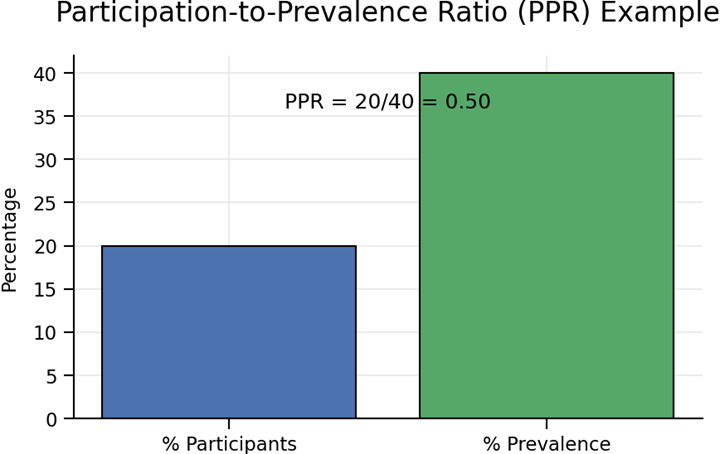
The PPR is calculated by dividing the percentage of trial participants in an age group by the percentage of disease prevalence in that same group. The PPR provides a single, easy to use number that can be used to assess a representativeness of a study, make comparisons between studies, or track inclusion during enrollment. However, there are potential disadvantages to consider. Calculating PPR requires knowing the age-specific prevalence of the conditions of interest which may not be available. Additionally, the PPR is unidimensional, only characterizing one measure of representativeness at a time.